Mailing a Kit Is Not Delivering Screening
How a Jefferson outreach redesign connected an unfamiliar FIT kit in a patient's home to a valid result, diagnostic responsibility, and the next screening interval.

Role
Operational redesign lead
Jefferson Health Enterprise Population Health 2023–2024
My role and where the work stands
My role in the work
I led the operational analysis and redesign under the Director of Population Health, who held the payer relationships, constraints, sponsorship, and review; I developed the operating approach and patient materials, trained the outreach team, continuously monitored and managed the program, reported results, maintained the shipping system and working spreadsheet, and handed both to another team member, while payer contracting, clinical policy, laboratory products, and the surrounding Jefferson operations remained with their responsible owners.
Where it stands
Across two sequential, nonrandomized cohorts of approximately 800 patients each, valid FIT results within the same 90-day window increased from approximately 18–23% at baseline to approximately 45% after the combined redesign; this comparison measures the bundle through valid-result completion, while component effects, diagnostic-colonoscopy completion, clinical outcomes, repeat-year adherence, and savings require separate study.
Contents
The package that arrived said almost nothing
A staff member wrote an address by hand on a plain manila envelope. It had no Jefferson logo. Inside was the laboratory's flat fecal immunochemical test (FIT) kit and brief or uneven supplemental guidance. Then an unfamiliar clinical object arrived in a patient's home and asked for a private, awkward task without much help explaining what it was, why it mattered, how to complete it, or what would happen next.
The operating pattern had treated shipment as though it were delivery of screening. If a patient did not answer the initial outreach, the kit could simply be sent. The order and mailing were visible to the organization; everything the patient still had to understand and do was less visible.
A mailed kit becomes usable care only when the organization designs the presentation, instructions, trust, reminders, support, return, valid result, and clinical responsibility around it. That complete service is how screening reaches a patient.
Owning the path, then handing it off
I led the operational analysis and redesign under the Director of Population Health. The Director owned the payer relationships, defined the problem and available-resource constraints, sponsored the work, and reviewed the program. Within those boundaries, I developed the operating approach and patient materials, taught the outreach team to use them, monitored and managed the program, reported results, and maintained the shipping system and working spreadsheet.
When I left, I handed the system and spreadsheet to another team member. The program continued through later annual cycles. That continuity establishes implementation persistence rather than sustained effectiveness. Payer contracting, clinical policy, laboratory products, and the surrounding Jefferson operations remained with their responsible owners.
The broader Philadelphia region had colorectal-screening need in the hundreds of thousands, but that was not the project denominator. The attributed population-health program involved several thousand eligible patients. The study described below was smaller still: two cohorts of approximately 800 patients each.
Redesigning the package as a pathway
The team learned to print envelopes and later obtained custom ones. A recognizable Jefferson-branded outer envelope with printed patient and return addresses replaced the anonymous presentation. Revised offer language and an explanatory voicemail prepared the patient for what was coming. A detailed plain-language guide sat with the kit. A QR code led to an instructional video, and the same video route appeared in MyChart. Planned reminders, reachable staff, the shipping workflow, and a return-tracking process surrounded the object after it left the office.
Package and pathway
From a mailed object to a supported screening path
- 01
Recognizable package
A printed Jefferson envelope made the sender and return path legible.
- 02
Guide, video, and support
Detailed instructions, a QR video, the MyChart route, reminders, and reachable staff surrounded the kit.
- 03
Observed-return follow-up
Shipping and successful-return experience helped staff notice an outstanding kit that had become an exception.
- 04
Valid result
The measured endpoint was a valid resulted FIT, not an order, mailing, contact, or agreement.
The approximately 45 percent result belongs to the combined bundle. This reconstruction does not assign the change to any one component.
These elements formed one bundle. The envelope, guide, voicemail, video, reminders, and staff support were not separately tested interventions, and the result cannot be assigned to one of them. Their shared purpose was to make the next action legible to a person at home.
Evidence folio
A home test arrived as a complete service
This Cologuard product image was part of the project's comparative operating context. Its dedicated box, collection materials, patient guide, labels, return logistics, video guidance, and support model helped make visible how much service can surround a home test.
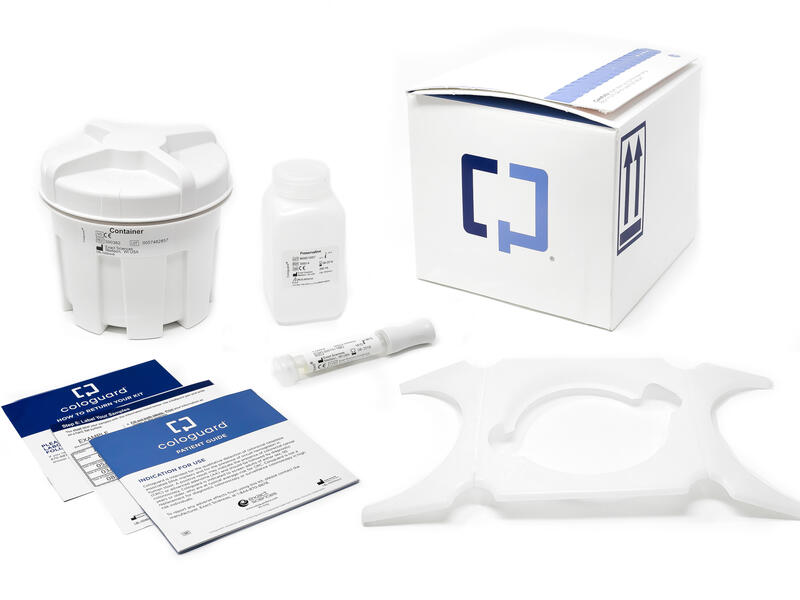
An external product image from the project record, showing the collection materials, instructions, labels, return packaging, and support model Cole studied. Jefferson's FIT results came from a different test and outreach pathway.
An external Exact Sciences laboratory-database study offers context for that support model. It reported 71.1 percent valid-order-to-valid-result completion within 365 days among 368,494 fully insured Medicare beneficiaries ages 65–85 with valid orders. Its population, denominator, modality, observation window, and vendor navigation model differ from the Jefferson FIT cohorts, so the percentage is not a benchmark or target for this project.
Following the return, not inventing a reminder clock
The spreadsheet carried an operational question the mailing record could not answer: when had an outstanding kit become an exception worth a staff call? It used observed shipping speed and successful-return timing, including ZIP-code-related delivery patterns, to identify kits that had moved beyond the period in which a return remained likely.
For staff, the spreadsheet served as empirical decision support rather than an automated contact engine or predictive clinical model. I do not confidently recall a fixed day-by-day reminder schedule. What persisted was delivery-aware, exception-driven follow-up: notice a likely missed return and give a person another understandable route to complete the task or ask for help.
Exception-driven follow-up
Notice the kit that has moved outside the observed return window
The spreadsheet supported a staff decision. It did not encode a surviving formula, fixed reminder cadence, automated contact engine, or predictive clinical model.
-
Shipment
Record that the kit entered the mailing workflow.
-
Observed window
Use delivery and successful-return experience, including ZIP-code-related patterns, as operating context.
-
Outstanding exception
Identify a kit that has passed the period in which a successful return still appeared likely.
-
Staff follow-up
Place the exception in a human-owned follow-up queue rather than assuming noncompletion.
Evidence folio
The reminder was part of the care path
This Jefferson FIT follow-up graphic was used during the 2023–2024 project. It asked for the kit's return, acknowledged that the patient might already have sent it, and supplied phone and MyChart support when the kit had not arrived or a question remained.
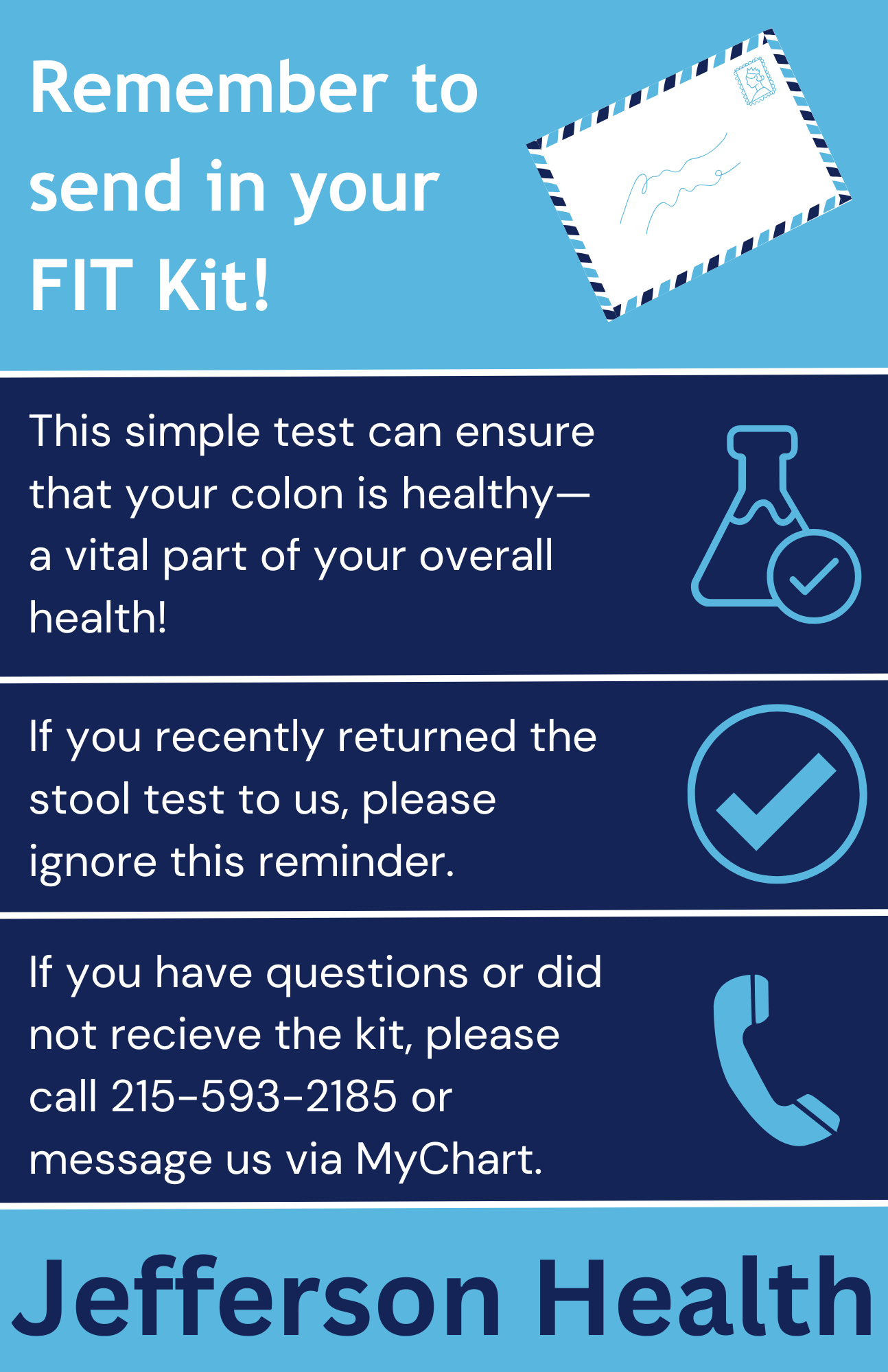
Historical Jefferson project material, not current contact instructions, policy, or proof that the program still operates. The visible support routes show that return logistics and reachable help were treated as part of delivery.
Valid-result completion and the next measurement layer
The quality-improvement comparison used two sequential, nonrandomized cohorts of approximately 800 patients each. The cohorts came from the same plan and year. The design matched or accounted for population demographics, the time window, outreach channel, and outreach staff. Both cohorts had the same 90-day follow-up window and the same endpoint: a valid resulted FIT.
Rounded valid-result completion was approximately 18–23 percent in the baseline cohort and approximately 45 percent after the complete redesign bundle. Completion was substantially higher after the bundle. The comparison was not randomized, did not isolate an envelope or reminder effect, and did not establish statistical significance or rule out every competing change.
FIT completion comparison
Valid-result completion was substantially higher with the redesigned bundle
Data table
| Cohort | Design | Patients | Valid-result completion |
|---|---|---|---|
| Baseline | Sequential, nonrandomized | Approximately 800 | Approximately 18–23% |
| Redesigned bundle | Sequential, nonrandomized | Approximately 800 | Approximately 45% |
This comparison ended at a valid FIT result. Further evaluation would need to follow diagnostic-colonoscopy completion, cancers detected, stage shift, repeat-year adherence, and savings. Estimating lives saved would require a longer and more demanding study.
One valid result is only the first completion layer
The endpoint still matters because an order, mailing, message, agreement, or returned-but-unprocessable kit falls short of a valid screening-test result, and even a valid stool result leaves further responsibilities. An abnormal result calls for diagnostic colonoscopy without becoming a cancer diagnosis in itself, while a negative result leaves someone responsible for the next screening interval.
The operating record therefore needs three distinct measures: Screening-test completion, Abnormal-result follow-up, and Repeat-interval completion. Each closes a different responsibility.
Three completion layers
A valid result closes one measure, not the whole pathway
- 01 · Measured here
Screening-test completion
A valid laboratory result, not an order, mailing, message, agreement, invalid return, or referral.
- 02 · Separate responsibility
Abnormal-result follow-up
Diagnostic colonoscopy after an abnormal stool result. A positive stool test is not a cancer diagnosis.
- 03 · Longitudinal responsibility
Repeat-interval completion
The next screening round after a negative result, at the interval appropriate to the modality and patient.
Current average-risk guidance makes the longitudinal burden concrete: FIT is generally annual, stool DNA-FIT is operationalized every three years after a negative result under current CDC/CMS guidance, and a normal average-risk screening colonoscopy generally carries a ten-year interval. Ages, risk, symptoms, prior findings, preferences, and clinical judgment belong in the local clinical pathway. These intervals are current general guidance, not Jefferson policy or a universal protocol.
The financing horizon changed the question
The work also raised a structural economic question. A home-test pathway has an acquisition price, but it also moves work among patients, outreach staff, laboratories, vendors, clinicians, and future screening rounds, while prevention may create value on a longer horizon than the organization paying today can reliably capture. That mismatch can make a clinically valuable pathway look less attractive in a short-term budget.
A serious comparison has to name its perspective, time horizon, repeat interval, staff work, invalid kits, diagnostic-colonoscopy responsibility, and membership or attribution assumptions. The project did not examine payer policy or motive, and it did not measure realized savings, avoided cancers, or financial return.
Carry the pathway into a local plan
Supporting documents
Use the screening outreach field checklist
The checklist distinguishes the 2023–2024 Jefferson practices from current guidance and the decisions another organization must make locally.
Planning checklist
Colorectal screening outreach field checklist
Define the eligible population, three completion layers, modality intervals, package and support sequence, return and invalid-kit handling, staff ownership, measures, economics, and launch readiness.
Use the checklistThe adjacent Epic population-health messaging work goes deeper on reusable communication across preventive-care topics. Here, the message remains one part of a larger colorectal pathway: physical package, instruction, shipping, response timing, staff exceptions, valid result, diagnostic responsibility, repeat interval, and financing horizon.
Jefferson Maps addressed a related moment of delivery. A verified location becomes useful only when a staff member can explain a workable next step while the patient is ready to act. In both projects, information became care through the organizational work surrounding it.
Notes
The CDC screening guidance, CMS130v14 for the 2026 performance period, and USPSTF recommendation supply the current average-risk ages, screening intervals, and diagnostic-colonoscopy distinction. Jefferson's project history and results come from the internal operating record described above.
The Community Preventive Services Task Force multicomponent finding supports combining approaches that increase demand, access, and delivery. Jefferson tested its envelope, voicemail, instructions, QR video, reminders, and staff support as one bundle, so their individual effects remain unknown.
Miller and colleagues' Exact Sciences laboratory-database study reported 71.1 percent completion within 365 days among 368,494 fully insured Medicare beneficiaries ages 65–85 with valid orders. It is external context for a vendor navigation model, not a Jefferson comparator, benchmark, population-denominator result, or diagnostic-follow-up measure.
The CDC colorectal program-resource study shows why nonclinical planning, contracting, management, and tracking work belongs in program cost. Jefferson did not measure comparable costs, long-run modality economics, payer savings, or realized return.