Wake Technical Community College
Wake Tech Formation
Wake Tech was where community college became the real intellectual unlock: in-person classes after rural Maine, Psychology 150 and sociology back-to-back, engineering club leadership, technical labs, math struggle, and the first serious evidence that education could remake my operating model.
- Community college transfer pathway
- Psychology 150
- Sociology
- Computer science and electrical engineering
- Engineering club
- technical formation
- community college
Project note
In Brief
Wake Tech was where community college became the real intellectual unlock: in-person classes after rural Maine, Psychology 150 and sociology back-to-back, engineering club leadership, technical labs, math struggle, and the first serious evidence that education could remake my operating model.
Relevant To
- community college students
- nontraditional students
- students leaving restrictive education environments
- technical learners
- healthcare and engineering educators
Search Context
- why community college can be transformative
- Wake Tech computer science and engineering student story
- how psychology and sociology can change a technical career
- community college to healthcare systems engineering
4 cited sources
In Brief
Wake Tech was where education became real for me. Moving from small-town Maine into the Raleigh area, taking psychology and sociology back-to-back, joining engineering spaces, and struggling through calculus all changed how I understood science, people, leadership, and my own trajectory.
Why It Matters
I wrote this for community college students, transfer students, technical learners, educators, and anyone who thinks prestige is the only path to serious intellectual formation.
It also explains my respect for community colleges. Wake Tech did not feel like a backup plan. It felt like the first place where the world opened up in a practical, affordable, in-person way.
Operating Context
When my family moved from Maine to North Carolina, the scale change was enormous. Ellsworth, Maine was a small town of roughly 7,000 people. Raleigh was an urban environment in the hundreds of thousands. Compared to where I came from, it felt like a major city.
Wake Tech became the bridge into that larger world.
I still think Wake Tech is one of the best community colleges in the country. More importantly, it taught me how much a place and a group of teachers can change a person’s model of reality. It was in-person education, technical exposure, social science, peer learning, and leadership practice in one environment.
What We Built
The build here was a foundation.
I completed 68 credits at Wake Tech, just short of a full associate degree. I studied computer science and electrical engineering, but the classes that changed me most immediately were Psychology 150 with Courtney Perry and a sociology class I took back-to-back with it.
Those courses hit at the same time. Psychology gave me a new way to think about behavior, cognition, development, and evidence. Sociology gave me a new way to think about institutions, groups, culture, and belief. Together, they changed my relationship to science, religion, biology, and the future I thought was possible.
That was when I started to fall in love with biology, evolutionary biology, evolutionary science, and eventually evolutionary medicine. It was also when I started to recognize that the strictness of my religious upbringing was not going to be compatible with the kind of scientific and medical life I wanted.
The technical side mattered too. Wake Tech’s engineering club was excellent. We built structures, worked around people who had been involved in NASA clubs and space camp, and learned by making things with peers who were excited by engineering. I was young, roughly 16, and suddenly around people who made technology feel normal.
For some tests and activities, I also had to go farther out to Wake Tech’s RTP presence. Seeing technical infrastructure, including Lenovo server-farm context, was a very different world from rural Maine. It made enterprise technology feel physical and local.
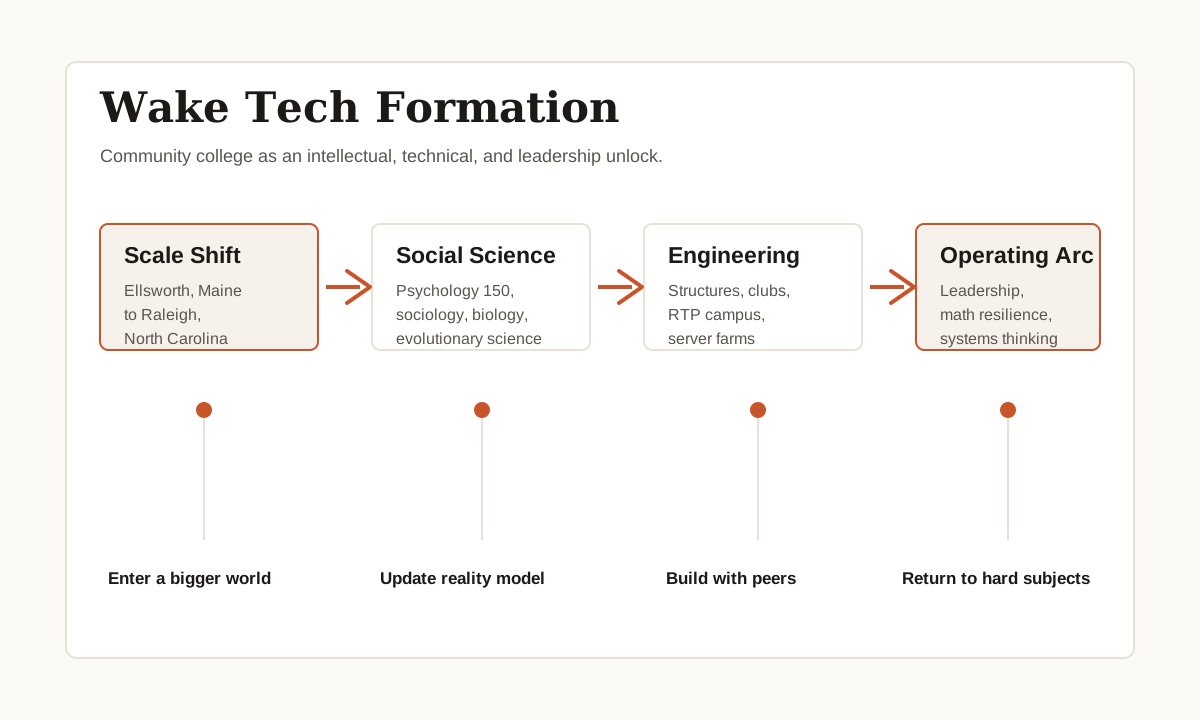
Wake Tech Formation Map
The arc was scale, social science, engineering, then resilience. Wake Tech made education feel like something I could actually inhabit.
Implementation Playbook
For students trying to use community college well, my playbook would be:
- Treat community college as a serious institution, not a waiting room.
- Take at least one social science class seriously, even if you are technical.
- Find the professors who change how you think and remember their names.
- Join a club where people build, debate, or organize something together.
- Put yourself around peers who make the next version of your life feel normal.
- Use affordability as strategic freedom.
- Do not let one hard class define your intellectual identity.
- Revisit the subject that beat you later, when you have better tools.
- Transfer the confidence along with the credits.
- Notice when education is changing your values as well as your transcript.
The most practical lesson is that environment matters. I needed a place where psychology, sociology, engineering, math, and peer leadership were all close enough to touch.
Standards, Governance, And Validation
The religious and family context is part of my lived experience. It explains why Wake Tech mattered without making a universal claim about every Jehovah’s Witness family or religious community.
The same care applies to my father. I love my dad. I do not write about this to sound bitter. At the time, the engineering club leadership term was cut short because my family viewed the association as too worldly. My father has also regretted some decisions in hindsight. That complexity matters: people can love you, be proud of you, and still make choices inside a worldview that limits you.
The validation standard for the account is not a formal outcome study. It is whether the experience explains later operating behavior:
- Why do I respect community colleges?
- Why do I take social science seriously in technical work?
- Why do I care about evidence and reality-testing?
- Why do I see math struggle as temporary rather than identity?
- Why do I now connect engineering, healthcare, and human systems?
Results And Evidence
| Signal | What It Shows |
|---|---|
| 68 completed credits | Wake Tech was a substantial educational foundation, not a brief exposure. |
| Psychology 150 and sociology back-to-back | Social science changed how I understood people, belief, culture, and evidence. |
| Engineering club leadership | I started practicing technical peer leadership young, even though the term was cut short. |
| Northern Wake and RTP campus exposure | Community college connected me to real technical infrastructure and a much larger regional economy. |
| First and only F in calculus | Math was hard before it became useful. |
| Later A in calculus at UNC Charlotte | The early failure did not define the subject or my ability to return to it. |
| Current statistics-heavy work | The math thread came back through healthcare analytics, operations, and AI validation. |
The most important result is not the 68 credits. It is that Wake Tech changed my relationship to education from aspiration to practice.
My Operating View
Wake Tech taught me that a community college can be an elite experience if the teaching is strong and the student is ready to be changed.
I do not mean elite in the branding sense. I mean elite in the useful sense: the kind of place that gives a motivated student a new model of science, society, technology, leadership, and self-respect.
Psychology and sociology mattered because they made reality bigger. Engineering club mattered because it made technical ambition social. Calculus mattered because failing it taught me that difficulty is not destiny. Years later, getting an A in calculus at UNC Charlotte felt like closing a loop.
That loop still shows up in my work. I use math and statistics constantly now. I work across healthcare systems, AI, analytics, and operations. The version of me who failed calculus at Wake Tech would not have believed that. Wake Tech gave me enough structure to eventually prove him wrong.
The later path runs through CS50 technical formation, UNC Charlotte science and public health formation, and then into clinical and operational work like iScribe ambulatory documentation.
Reusable Checklist
Use this checklist if you are trying to turn community college into a real formation experience:
| Move | Why It Matters |
|---|---|
| Take one class outside your identity | A technical student may need psychology; a healthcare student may need programming. |
| Build with peers | Clubs and projects teach social confidence alongside content. |
| Learn from professors by name | One strong teacher can change your operating model. |
| Track which beliefs stop surviving contact with evidence | Education should update your reality model. |
| Keep hard classes in perspective | A bad grade is data, not destiny. |
| Use transfer pathways intentionally | Credits matter, but the goal is momentum and confidence. |
| Visit technical spaces | Labs, server rooms, campuses, and industry sites make technology tangible. |
| Let affordability create optionality | Lower-cost education can create room to explore without catastrophic risk. |
The practical advice is simple: do not sleepwalk through community college. It may be the most important educational environment you ever get.
References
Wake Technical Community College, the Northern Wake Campus, Raleigh, and Ellsworth provide the public context. Details about Courtney Perry, the sociology professor, engineering club, calculus, family context, and personal religious transition are my recollection.
The page does not claim Wake Tech officially ranked among the best community colleges in the country. The stronger claim is personal and specific: Wake Tech was a serious, affordable, transformative institution in my life, and it helped create the technical and social-science foundation behind my later healthcare systems work.
Frequently Asked Questions
- Why did Wake Tech matter to me?
- Wake Tech gave me in-person education, social science, engineering peers, technical labs, leadership practice, and enough academic friction to learn resilience. It moved education from distant aspiration into daily practice.
- How can community college shape a technical career?
- Community college can combine affordability, access, strong teaching, technical labs, clubs, and transfer pathways. For a motivated student, that can create both the academic foundation and the social proof needed to keep going.
- Why do psychology and sociology matter in a technical formation story?
- Technical work is still human work. Psychology and sociology gave me a broader model of behavior, institutions, belief, culture, and evidence, which later mattered in healthcare strategy, population health, and AI systems.
Cited Sources
- Wake Technical Community College Wake Technical Community College
Public context for the institution at the center of this formation story.
- Northern Wake Campus Wake Technical Community College
Public context for the campus I commuted to.
- Raleigh, North Carolina QuickFacts U.S. Census Bureau
Public demographic context for Raleigh as the larger urban environment Cole moved into.
- Ellsworth, Maine QuickFacts U.S. Census Bureau
Public demographic context for Ellsworth, Maine as my small-town point of comparison.