Patient Safety and the Slack in the Institutional Line
Reporting a safety concern is only the beginning. What happens when a request moves through an organization while the risk remains?
Contents
During my clinical support work, I repeatedly saw adult-sized wheelchairs being used for smaller patients, including children. The chairs did not always fit the people who needed them, and disorganized arrivals and repeated room moves made the problem harder to manage. I also saw a fall in a waiting area.
I raised the equipment concern through two management levels. When those conversations led to no response that I could see, I also reported it anonymously in an employee survey. I have withheld identifying details about the people and setting.
The firsthand account stops there: a repeated equipment problem, a fall I saw, and reports that produced no obvious next step. It does not establish how those reports were handled afterward.
How a warning becomes a routine request
That experience raises a wider question about how an organization hears a safety concern. A member of staff may be worried that a patient will fall, while the person reviewing the budget sees a request to buy another wheelchair. If the request loses the reason behind it, a safety concern can look like a purchase that can wait. The request may also be set aside because the equipment seems too expensive, while the original safety concern remains.
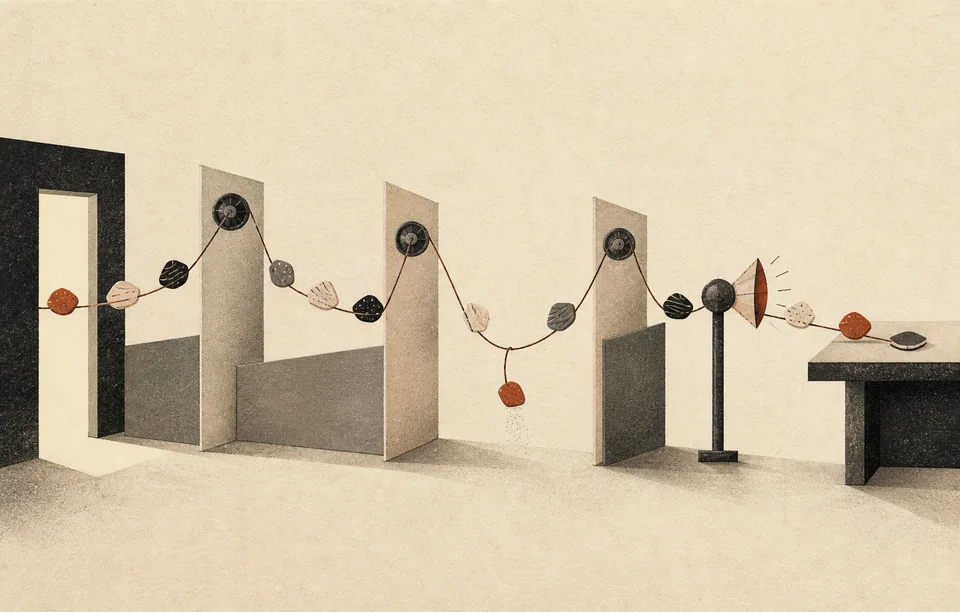
This is what I mean by slack in the institutional line. A concern can pass through the organization while losing the details that made it urgent. The people who see the risk may have little authority to change it, and the people with that authority may never hear the full explanation.
That does not necessarily mean anyone is indifferent. People are working with different information and different responsibilities. A useful reporting process needs to carry enough context for someone to understand what could happen to the patient, decide what needs attention, and explain what will happen next.
Make clear who will respond
AHRQ's guidance on safety culture and high reliability asks organizations to make it possible for people to report concerns without fear of unfair blame. It also asks leaders to pay attention to everyday work and listen to the people who know it best. 1 Culture of Safety and High Reliability AHRQ describes reporting without unfair blame, attention to everyday work, and respect for the knowledge of people closest to it. Open source Read full Note 1 A policy or a new system needs that attention after it has been introduced, when staff and patients begin to encounter problems that were not obvious during planning.
A review needs to look at what happened and what made it possible before deciding who is responsible. Reckless conduct may still have consequences, but blaming someone before understanding the situation can discourage others from reporting the next problem.
If the review finds a safety problem, the response should address what caused it. AHRQ's root-cause-analysis guidance emphasizes changes that address the conditions behind an event and checks whether those changes work. The Veterans Health Administration's Healthcare Failure Mode and Effects Analysis looks for ways a process could fail before harm occurs. 2 Root Cause Analysis and Proactive Risk Assessment AHRQ describes investigating events and checking corrective actions; VHA describes reviewing possible failures before harm occurs. Open source Read full Note 2
For the wheelchair problem, a proposed change might include checking whether the available chair fits the patient and assigning someone to arrange a suitable alternative when it does not. The organization would then need to check whether the problem recurs. A report is more useful when someone is responsible for following it through.
Keep listening after technology goes live
If staff repeatedly dismiss an alert or patients cannot complete a portal step, someone needs to understand why. The problem may lie in the tool or the way work is organized, even if the first report describes only what the user did.
The SAFER Guides and the Health IT Playbook give organizations a way to check the safety of their electronic health records. That includes looking at how test results are followed up, how clinicians communicate, and what happens when the system is unavailable. 3 SAFER Guides The guides cover ongoing responsibilities for EHR safety, including downtime, test-result follow-up, and communication. Open source Read full Note 3 Those checks need to continue after the system is launched.
In their Health IT Safety Framework, Singh and Sittig ask whether the technology itself is safe, whether it is being used safely, and whether it can help make care safer. A system can work as designed and still make a task harder to do safely.
A workaround alone does not prove that a system has failed. Research on health IT safety and workarounds offers a way to examine what staff were trying to do, why they took a different approach, and what risks it introduced. The organization also needs to decide who can change the tool or the process if the review finds a problem.
What restraint and seclusion figures leave out
The way a concern is described also matters when organizations measure restrictive practices. Before my clinical operations work, I examined this in a seven-page undergraduate paper submitted on December 10, 2023, “Seclusion in Healthcare: Alarming Trends or Data Challenges?” This was academic research, not an account of clinical restraint or seclusion practice.
I questioned whether calling seclusion an alternative to restraint could make the remaining harms less visible. Both restrict a person's freedom. Differences in definitions and reporting can also make it difficult to tell whether a change in the figures reflects safer care.
Federal hospital rules allow restraint or seclusion only to protect the immediate physical safety of the patient or others, when less restrictive measures have been judged ineffective. They require the least restrictive effective option and an end to the intervention as soon as possible. Seclusion is further limited to violent or self-destructive behavior. Professional guidance also emphasizes assessment, documentation, review, and alternatives. 4 Condition of participation: Patient’s rights Hospital rules require an immediate physical-safety purpose, the least restrictive effective intervention, and prompt discontinuation. Seclusion has an additional behavioral restriction. Open source Read full Note 4
Those requirements do not remove the need to consider the patient's experience. APA and SAMHSA guidance asks organizations to consider trauma and fear, and to keep patients involved in decisions about their care. A change in the intervention's name does not tell us whether the patient feels safer. 5 Trauma and patient experience APA and SAMHSA address trauma, patient experience, and ways to keep people involved in decisions about their care. Open source Read full Note 5
The Joint Commission's measures count physical-restraint hours and seclusion hours separately, and CMS runs the federal inpatient psychiatric quality-reporting program. 6 HBIPS-2 and HBIPS-3 The measures count physical-restraint and seclusion hours separately. Those figures do not describe everything a patient experienced. Open source Read full Note 6 If restraint use falls while seclusion use rises, the restraint figure alone cannot tell us whether care has become less restrictive. Review also needs to consider what patients experienced, what alternatives were tried, and whether a restrictive practice became routine.
What happens after someone speaks up
I think the first response to a concern can affect whether people keep speaking up. If reporting repeatedly produces no visible response, staff may conclude that nothing will change. Leaders may then hear less about problems that patients and staff continue to encounter.
A useful response makes clear who will look into the concern, what they will do next, and how they will check any changes. If a proposed change cannot be made, someone should explain why and what will happen instead. The person who raised the concern should be able to find out what happened to it.
The question I trust is, “What made the work happen this way, and what would make it safer next time?” Leaders do not need to be present for every task to ask that question. They do need a reliable way to hear from the people doing the work and receiving care, with enough context to act before the same problem causes harm.
Notes
- AHRQ, “Culture of Safety” and “High Reliability,” Patient Safety Network (2019; reviewed 2024). AHRQ connects non-punitive reporting with sensitivity to operations, preoccupation with failure, resilience, and deference to frontline expertise. Culture of Safety; High Reliability. ↩
- AHRQ, “Root Cause Analysis,” Patient Safety Network (2019; reviewed 2024), and VHA National Center for Patient Safety, “Proactive Risk Assessment,” (updated 2026). AHRQ emphasizes corrective action and follow-up measurement; VHA describes proactive risk assessment, including Healthcare Failure Mode and Effects Analysis. AHRQ Root Cause Analysis; VHA Proactive Risk Assessment. ↩
- Office of the National Coordinator for Health Information Technology, “SAFER Guides” (2025 guides; page updated February 27, 2026), and “Health IT Playbook: Quality & Patient Safety” (accessed October 31, 2026); Singh and Sittig, “Measuring and improving patient safety through health information technology: The Health IT Safety Framework” (2016); Recsky et al. (2024); and Blijleven et al. (2022). The government guides treat EHR safety as continuing organizational work; the research examines the interaction among technology, workflow, governance, and workarounds. SAFER Guides; Health IT Playbook: Quality & Patient Safety; Singh and Sittig; Recsky et al.; Blijleven et al.. ↩
- 42 C.F.R. § 482.13, “Condition of participation: Patient's rights,” current regulation, and American Psychiatric Nurses Association, “Standards of Practice: Seclusion and Restraint,” revised 2022. The regulation limits restraint and seclusion to immediate physical safety when less restrictive measures are ineffective, requires the least restrictive effective option and prompt discontinuation, and further limits seclusion to violent or self-destructive behavior. APNA addresses prevention, assessment, monitoring, documentation, and review. 42 C.F.R. § 482.13; APNA Standards. ↩
- American Psychiatric Association, “Resource Document on Seclusion or Restraint” (2022), and SAMHSA, “Trauma-Informed Approaches and Programs” (accessed October 31, 2026). These sources address trauma, patient experience, and restrictive interventions. Haugom et al. (2019) examine Norwegian staff accounts of seclusion, whose local definition includes staff presence and differs from US regulatory seclusion. Bowers et al., “Seclusion and Psychiatric Intensive Care Evaluation Study (SPICES)” (2017) evaluate the use and outcomes of coercive practices. APA resource document; SAMHSA trauma-informed approaches; Haugom et al.; SPICES. ↩
- The Joint Commission, HBIPS-2 and HBIPS-3, 2026A manual, and CMS, “Inpatient Psychiatric Facility Quality Reporting (IPFQR) Program,” updated 2026. The Joint Commission counts restraint and seclusion separately, while CMS administers the federal reporting program. Those measures do not describe the full patient experience. HBIPS-2; HBIPS-3; CMS IPFQR. ↩
Sources and methods
The wheelchair account comes from my supervised clinical support work; I have withheld the employer, facility, people, dates, and private records to protect confidentiality. My undergraduate research informs the discussion of seclusion. The numbered Notes identify the public patient-safety and health-IT sources behind specific claims. The argument about how concerns travel through an institution is my interpretation. The proposed responses are recommendations, not outcomes I observed in the wheelchair account.
About the illustration